
1951 to 1953
Contents
| World-wide background to the 1950's | |
| UK in the 1950's | |
| National Service | |
| Induction | |
| GO TO | 'Kitting out' |
| GO TO | Basic Training |
| GO TO | 'Passing Out' |
| GO TO | Trade Training |
| GO TO | Air Traffic Control |
| GO TO | Off Duty Life |
| GO TO | The Good, the Bad the Ugly |
| GO TO | Sex |
| GO TO | Pay Day |
| GO TO | Flying |
| GO TO | Epilogue |
World-wide
background to the 1950's
It would be easy to view the 1950s with rose-coloured glasses and remember it as a period of innocence and tranquillity. But, of course, like all of our history, it wasn't. The aggression of the human race seems to make it unable to create lasting conditions of peace.
Over
the past few years younger people have frequently asked me why there was a need
for conscription in the UK four years after the Second World War had ended. I
have attempted to answer that question in this chapter.
Wars, large and small, have been with us since time immemorial and age-old animosities between nations didn't stop because another World War had ended. The reasons for these conflicts, which continue even today, remain varied. They can be political, tribal, religious, economic or racial. As I write this article and to illustrate my point, there are 14 civil wars, major and minor, currently raging in Africa alone.
The
First World War was supposed to be 'the war that would end all wars'.
Twenty-one years later the Second World War erupted and we fervently hoped that this
one would be the last. When that war ended the 'Cold War' commenced and
Communism spread throughout the globe.
Sir
Winston Churchill forecast this in a speech he made in the USA in 1946, when he
spoke of an 'Iron Curtain'. He used this phrase to describe the dividing
line between the Western World and those Communist-run countries such as in
Eastern Europe, Russia and China. He had the foresight to anticipate the future
problems that the Western World would suffer from Communism in its many forms.
The
Cold War created a hostile atmosphere between democracy and communism, which
resulted in a series of threats, and counter-threats between the leading
protagonists. They were the United States of America and the main proponents of
communism, who were Russia and China
In
addition to the threat of World War III commencing, the other nightmare that
existed during this period was the threat of a nuclear war. The initial monopoly
of the atomic bomb by the United States briefly held such fears at bay.
In
1949 the Soviet Union exploded its own atomic bomb and then during the 50s, both
Russia and the United States proceeded to develop the far more destructive
hydrogen bomb. The rest of the world started to wonder where all this would
lead. Many people thought we had created the seeds for our own self-destruction,
which would ultimately lead to the annihilation of our planet.
After
the Second World War there was to be no return to peacetime soldiering.
Occupation forces had to be found for Western Germany, Berlin, Austria and the
disputed area around Trieste, which was being claimed by both Italy and
Yugoslavia.
Numerous
mini wars developed around the world and although some were called 'police
actions', many British troops were killed in them.
Our
servicemen were sent to subdue a communist uprising in Greece. Sabotage and
terrorism in Palestine cost the lives of 223 of our officers and men. British
occupation forces had to be found for French Indo-China and the Dutch East
Indies after Japan's defeat. British battalions had to be called out in India
to support the police during the anti-British riots and looting that took place
over the demands for independence and the transfer of power.
We
had troops on reserve in the Middle East spread over Egypt, Libya, Cyprus,
Somaliland and the Sudan, further garrisons in the Far East and smaller forces
in Gibraltar, Malta and the Caribbean. Much of this was brought about by the
growing clamour for independence in Asia and Africa.
In
1950 the North Korean army invaded South Korea. The British Army was called upon
to assist the Americans and South Koreans and acquitted themselves well but at
great cost. The Chinese communists had joined the conflict and they killed many
of our servicemen. If they were captured they were brutalised for years.
One
of the longest campaigns undertaken by the Army was the struggle to save Malaya
from a take-over by the country's predominantly Chinese Communist Party. While
this was going on, a State of Emergency commenced in Kenya over Mau Mau
atrocities towards Europeans and other Africans. It took four years and the
services of 11 British battalions and the King’s African Rifles before the
last of the Mau Mau gangs were eliminated.
As
I said at the beginning, it is convenient and more comfortable to romanticise
about the past and forget the unpleasant things that occur during your life. It
would be easy to do this with the 1950s because they occurred so long ago. But I
have to remind myself that a friend of mine, who chose to do his National
Service in the Army, died in the Korean conflict like many other British
servicemen. He was 18 years old.
My
schoolfriend John Davies was killed in the war when he picked up a
'butterfly' bomb in North Wales where he had been evacuated for
'safety'. He was only eleven. The years have not erased the memory of either
of them.
I have not even mentioned the Gulf War, Vietnam and the Falklands because they came much later. 'Man’s inhumanity to man' has probably cost billions of lives over the centuries and you cannot help wondering if it will ever end?
GO TO TOP
Those of us that were born between the two World Wars have seen incredible changes take place in the World. We live in an almost permanent state of disbelief at the extraordinary advances in medical science and technology.
In the 1950's the nation's economic, social and
financial climate was totally different to that of today (December 2000).
Because of World War Two, the 50's was a period of austerity and great social
upheaval. Women, who had worked in factories and on the land during the war, had
become used to having their independence and most wanted to retain it when their
menfolk returned from the battlefields. Those men –
especially the ones who had been in prison camps – often felt redundant, both
as men and as bread-winners. Wives had coped with children, jobs and all the
administration of daily life. In most cases, they had managed extremely well in
stressful times.
I’m not a historian or a philosopher but looking back on it
now it seems as though the 'man in the street' adopted a different attitude
to life after World War Two. With only 21 years separating the two World Wars,
people were fed up with conflict and the hardships they had endured. Ordinary
men and women lost their innocence. They no longer believed everything the
politicians told them.
Whereas drabness and austerity were perceived as qualities in
the war, people now wanted a better life for themselves and their families and
eventually things started to change – but it took a little time.
Some people have described the 50's as dull. Compared
with today, I suppose some aspects of it were, but to the young people who lived
through that time, like me, we had nothing to compare it with. Our youth was
just as exciting for us as it is for the young nowadays, only safer. At least it
was when the war ended and the bombs, rockets, and 'Doodlebugs' stopped
dropping around us.
In the early 1950s Mr and Mrs 'Average Person'
didn't have a colour TV, a car, a telephone, a computer, double-glazing,
central heating, washing machines, fridges or freezers.
What we did have were coal fires, chimney sweeps, outside
toilets and ration books. No immersion heaters or central heating
existed but some houses had a back boiler in their fireplace, which was fine in
the winter but sometimes inconvenient in the summer period. I can remember
taking a glass of water to bed in the winter and it would be frozen in the
morning. There would also be frost on the inside
of the bedroom window. Paraffin lamps and stoves were also widely used for
warmth but they ignited many nightclothes. The combination of smoke from coal
fires and fog, called smog, killed 4,000 people in 1952.
We kept diaries instead of filofaxes. We played cards, snakes and ladders and ludo instead of computer games. Gas lighting still existed in some parts of the UK. Large wet batteries called accumulators powered the radios in those houses, without electricity. The Dick Barton series on the radio was as exciting to us as James Bond is today. Nightlights, small flattish candles, were in common usage in children’s bedrooms.
Supermarkets and sliced bread didn't exist in the UK and sugar rationing didn’t end until 1953. We didn’t eat out because restaurants were too expensive. However, Lyons Corner Houses were popular, where waitresses nicknamed 'Nippies' served you.
Women
in that era sewed and knitted a great deal. Not as a hobby or to pass the time,
it was done for economic reasons. Sewing machines were operated by hand or with
a foot treadle.
There
were no fitted carpets at that time. Lino was the normal floor covering and, if
you could afford it, a carpet was laid in the middle of the room.
There were no fitted kitchens and no electric blankets. To warm the bed you needed a hot water bottle. Electric irons were a novelty and most people only had a flat iron that you heated up on a gas stove. There were no electric toasters so you pierced a slice of bread or crumpet with a toasting fork and held it in front of the fire.
We
knew the difference between the time for dignity and restraint and the time for
letting our hair down. A passing funeral cortege would command respect. People
would stop and bow their heads and men would remove their hats or caps.
In
the 1950's antibiotics for tuberculosis and the Salk vaccine for polio were
not widely available and both diseases were killers. The only effective cure for
tuberculosis was bed rest and two years of this wasn't uncommon.
We hadn't heard of global warming or greenhouse gases
and package holidays were a long way off. Gatwick wasn’t opened until June
1958 and Heathrow was a collection of huts. Bovingdon airport was used by Silver
City Airways for the occasional flight to Europe. There were many civilian
flights from local and sometimes ex-RAF airfields. Converted RAF planes were
used such as Dragon Rapides, Miles Marathons, Dakotas and Lancastrians. When we
went on holiday we dressed up for it. There were no shell suits, jeans and
trainers around in those days.
The 'designer' clothes for male teenagers consisted
of sharkskin shirts, thick crepe soled shoes called 'brothel creepers';
finger-tipped drape jackets and flashy ties imported from America. We called
such people 'spivs' and a popular hairstyle for them was the 'DA' or, to
be polite about it, 'Duck’s Anatomy'. In
the 1950's it was the custom to have clothes labels on the inside of the garment.
Credit cards and cashpoints were yet to arrive, together
with 24-hour shopping, McDonalds,
karaoke, videos, CD’s, disposable nappies, and 'streakers'. Mobile phones
were not available and manned space flight and satellites were still in the
imagination of little boys and science fiction writers.
Some of us remember the Mitsubishi as a Japanese fighter plane from World War Two, not anticipating that one day we would eventually have a video recorder and colour TV set made by the same company.
What is even more amazing is the fact that the video recorder alone contains more computing power than existed in the whole world in 1950. Cigarette smoking was fashionable but we had yet to see the intorduction of pizza houses, kebab shops, designer coffee bars, Chinese takeaways, gay lib, mixed wards in hospitals, the Pill, metal coat hangers and Coronation Street.
Playstations hadn't been invented so children read
books such as 'Rupert'. 'Just William', 'Biggles', 'The Swallows
and the Amazons' and the Famous
Five books by Enid Blyton. Some of the comics around at that time were
'Adventure' featuring 'Clicky Ba', and 'Champion' featuring
'Rockfist Rogan', There was also the 'Hotspur', 'Beano' and
'Dandy'.
No motorways existed anywhere in the UK in the 50's.
Breathalysers, parking meters and speed cameras were not around because they
weren't required. Car ownership was a luxury in that era.
A film called 'The Blue Lamp', which was made in
1949, shows quite clearly how few cars there were on our roads. Cycling was very
popular but riding a bicycle at night without lights could merit a 10/- fine
(50p).
If you did have a car or motorbike you could pull into a
garage and, at that time, it was quite normal to be served with fuel by a petrol
pump attendant. Petrol was
4/6d (0.23p) per gallon - we didn’t use litres in those days. Air for your
tyres was free and there were a variety of British motorcycles still being made
in the UK. My own 350cc Matchless, which I bought brand new in 1954, cost £200.
It is now a 'collectors item' and I wish that I had kept it.
We had buses, trams and trolley buses with a driver and a 'conductor'. The female conductors were called 'clippies'. When you purchased a ticket from them they punched it or 'clipped' it in their machines to indicate how far you could travel for the amount you had given them. Fare dodging was virtually non-existent because of the number of inspectors that were employed, who also ensured that buses kept to the timetable.
Compared
with today, home security was non-existent because Britain was a more honest
place to live. Front door keys were left under doormats or on a string just
inside the letterbox. Many people didn’t bother to lock their front doors at
all. Even though there was less crime, a
small country village would normally have supported a police establishment of
three men, consisting of a sergeant and two constables.
Light music was popular and played in the tempo of the
quick step, samba, foxtrot and waltz by the orchestras of Melachrino, Victor
Sylvester and Ambrose. Joe Loss and Ted Heath provided a more upbeat rhythm.
In
1955 along came the film 'Blackboard Jungle' featuring 'Rock around the
Clock' with Bill Haley and the Comets. Together with Elvis Presley who, in
1957 had eight hits in the UK Top 30 Chart, the music and social scene changed
forever after that. Mods and Rockers came along shortly after but it
was very long time before garage and hip-hop arrived.
The
Jazz and Swing music that appealed to me then, and still does, wasn't readily
available in the UK at that time. It meant scanning the dial for radio stations
such as Radio Luxembourg and AFN, the American Forces Network, which was beamed
all over Europe from West Berlin by the American Occupation Forces.
Records at that time were made of shellac, were 10" wide and played at 78rpm with a frequent change of needle. This limited the artist to three minutes of recording time. In the case of Jazz that was far too short a period, so it became essential for aficionados like me to listen to AFN and their 'V' discs, which lasted for much longer. 'V' discs, or Victory discs, were an early precursor of LP's or long playing discs.
St George's Day was celebrated with pride and it was a
time of celebration when Hillary and Tensing climbed Everest and Elizabeth II
was crowned in Westminster Abbey (1952). Respect was the normal behaviour of
children towards their parents, teachers, policemen, park-keepers and other
people’s property. The National Anthem was played at the end of every theatre
and cinema show and, at that time, we stayed to the finish.
Children didn't have to be supervised and entertained
at all times in the 50s and were more interested in playing 'Cowboys and
Indians', climbing trees, collecting newts and tadpoles, playing marbles,
'scrumping' and blackberrying. They were allowed to disappear for hours into
the countryside or town. This wasn't because their parents didn't care about
them, but because they knew they would be safe.
In 1951 George VI was on the throne, our future Queen had been married for four years and Prince Charles was three years old. The Labour Party lost the General Election and Sir Winston Churchill was once again our Prime Minister.
Two people from opposite ends of the social and political spectrum – Stalin and Queen Mary – both died in the same month – March 1953.
In the course of his control over Russia the monstrous Josef
Stalin was estimated to have been responsible for the deaths of 60 million of
his own people. It is difficult to believe in the existence of a merciful God
when men like him walk this planet, executing anyone that disagrees with them.
It is believed that Mao Tse Tung had even more killed than Stalin.
A
typical cinema show in the 50s would last approximately 3 hours and would
consist of two feature films and a newsreel. A certification system applied
which consisted of 'U' for Universal, 'A' for Adults, 'H' for Horror and a recently introduced 'X'
certificate. The obnoxious smell of popcorn wasn’t available, only ice creams,
sweets and, in some cinemas, soup would you believe. Smoking was permitted in
cinemas and everywhere else. In those days it was possible to go into a picture
house at lunchtime, having paid your 1/6d (7½p) and come out at 11pm having
seen three shows, if you wanted to, for no extra cost.
You
could also enter the cinema during mid-performance and remain there until
you'd seen the complete programme. With television in its infancy, films were
very popular in those days.
As a child and in all our innocence, if there was an 'A'
film that you particularly wanted to see and you didn’t have an adult to take
you, you waited outside the cinema and asked total strangers if they would take
you in.
It
is a natural human trait to look back on your own youth and remember only the
good things about it, deleting the imperfections from your mind. Nevertheless,
fifty years ago, the quality of life in this country was, in many respects, far
better than today. We had a more honest society and Britain was definitely a
safer place to live in than it is nowadays.
National Service
Apparently,
the Romans had a saying – 'If you wish for peace, prepare for war'….and
that was the reasoning behind post-war conscription, which was commonly known as
National Service.
In July 1947 the National Service Act was passed to become effective on 1st January 1949. This imposed an obligation on men conscripted of initially one year, then 18 months and from 1950, two years service. This was followed by a further obligation of three years in the Reserves.
When
the emergencies in Malaya, Kenya and the Middle East concluded and new national
flags were flying in the place of the Union Jack all over Asia and Africa the
Conservative Government, in the form of the Minister of Defence, Mr Duncan
Sandys, announced the gradual termination of National Service and the reversion,
from 1st January 1963, to all-volunteer Services.
Many
of the potential recruits, who were about to be conscripted, probably greeted
the news with pleasure. They knew they would now be able to avoid the discipline
and duties imposed upon their fathers, which was something many of their parents
would no doubt regret later.
Although
the Regulars were conscious of the debt that the Services owed to many National
Servicemen, particularly those that had lost their lives during their service
career like my friend in Korea, they were keen to be free of the time and
manpower-consuming problems connected with their training. They were also
reluctant to work alongside unenthusiastic and what they perceived to be
'civilians in uniform', many of whom seemed more concerned with their 'demob'
date than taking part in service life.
No
male was immune from conscription. If you qualified you were obliged to serve
but it was possible to temporarily postpone your period of service if you could
prove you needed to complete a period of professional training for your future
career in civilian life.
A
different principle was operated in the USA. They operated a selective service
system in which whether one actually donned a uniform depended heavily on such
factors as educational, occupational and marital status. This system broke down
during the Vietnam war ostensibly because of it’s perceived unfairness, but
also because of its failure to provide the kind of armed forces the USA needed.
My
mother’s timing was impeccable. She ensured that I was only seven when the
Second World War commenced. My war consisted of evacuation on three separate
occasions. I was sent to Northampton, Peterborough and Exmouth but managed to
return to London when the German bombers seemed to be most prolific. They were
particularly effective with their sticks of bombs and incendiaries at the London
Docks. For a time it became a nightly ritual watching the glow in the sky over
East London. It was like seeing the biggest firework display in the world. For
us children it was fun, for the adults it must have been their worst nightmare.
So
I missed the war but qualified for National Service. My three-year period in the RAF took me from Bromyard Avenue in West
London to RAF Upwood in what was then Huntingdonshire (nowadays it appears to be
in Cambridgeshire). Along the way, by courtesy of the Royal Air Force, I served
at Cardington, West Kirby, Compton Basset and Stradishall.
The author, just prior to call-up.
My
initial call-up letter told me to report to Bromyard Avenue and make myself
available all day for the intelligence and medical tests, which would be
followed by the selection process.
I
found the medical and intelligence tests to be fairly cursory, unlike those I
received later, when I was actually in the Service.
If
you only wanted to serve for the minimum period you were allowed to select
either the Army or Royal Air Force. Service in the Royal Navy required a
five-year commitment. If you chose either the Army or Royal Air Force you were
given the option of two or three years service. Because of my interest in flying
I chose the RAF.
When
I said I wanted to become a pilot, I was told I would have to sign on for eight
years. But even if I did there would be no guarantee that I would be successful.
Because
I wasn’t sure whether service life would suit me or not, I chose the
three-year period with a preference for Air Traffic Control. On reflection, I
think my interest in being a pilot was a fanciful idea which formed in my mind
as I watched Spitfires wheeling around in the sky over London, shooting down
enemy bombers and fighters.
Whilst
I was sitting in Bromyard Avenue awaiting my turn for the medical, I wondered
why there is a Royal Air Force, a Royal Navy but not a Royal Army? Does anybody
know? I would be interested to hear the answer.
The disaster of this airship in 1930 was due to a complete
disregard for safety by an Air Ministry team and was quite scandalous.
The R101 was rushed into production for a
‘prestige’ trip to India by the then Air Minister, Lord Thomson, who died in
the resulting crash, with 47 others. As I passed through the gates of RAF
Cardington, I sincerely hoped it wasn’t an omen on my future career in the
RAF.

Our
first contact with a Sergeant. He was the ‘kitting-out’
NCO at RAF Cardington. Name unknown, unfortunately, but he was a decent chap.
During that first week we were given further medical tests
which turned out to be far more stringent than those we had received at Bromyard
Avenue. 'Close inspection' took
on a different dimension when we were inducted into what was euphemistically
called 'the short arm' parade.
The
examination on the heart and lungs was OK and were what I had anticipated. But
when I had to bend over and have my rectum examined, then grabbed by the
testicles and told to cough, it was unlike any medical I had before.
Not
having been forewarned about this I began to be apprehensive about the kind of
service that I had joined. What other shocks were in store for me I wondered.
Were
all those rumours I'd heard, from my friends, about the 'Brylcream Boys'
true I wondered? No, as it happens, but it did cross my mind at the time.
After
the week spent at Cardington, we were sent to West Kirby, near Liverpool for
basic training or, as it became commonly known - ‘square bashing’.
Unfortunately
for us, we arrived there in an extremely cold January 1951; there was snow on
the ground and it felt as though we had been posted to the Antarctic. I don’t
think I ever got really warm for the whole of the nine-week period that I spent
at that camp.
Our
journey from Cardington to West Kirby was by train, but not on the regular
service. For some strange reason, the powers-to-be decided not to reveal our
ultimate destination to us.
To
do this and maintain an air of secrecy, they had arranged for all the windows of
the carriages to be blacked out. We were made to feel like prisoners of war and
this had the effect of, and I’m quite sure it was deliberate, to unsettle us
and I believe it was done to make us more receptive to instruction and
discipline.
I think they were working on the lines of ‘Whom the Gods wish to destroy, he first makes mad’.
However,
this bizarre tactic didn’t work on us. We all came from different parts of the
UK and, after tearing off some of the blackout, we put our heads together.
We
were able to work out, at any one time exactly what part of the UK we were in,
either from the terrain or the occasional station name we could see as we sped
by.
Our
new home at RAF West Kirby consisted of a series of wooden huts, a parade
ground, gymnasium, cookhouse and airmen’s mess, barber’s shop and guardroom.
If there were other buildings, such as a clinic or fire station, I was not aware
of them. In fact it was no different in appearance to the photographs of
prisoner-of-war camps I’ve seen. Other training camps in the UK, at that time,
were situated at Padgate and Bridgenorth.
During
our nine-week stint on this camp we seemed to be in a perpetual fast-forward
mode. The first item on our enforced agenda was to be ‘scalped’ by the camp
barber.
We
were rapidly marched into his ‘emporium’ where he seemed to take an indecent
pleasure in removing our cherished locks with aid of clippers, as though he was
shearing sheep. This was at a time when a shaven head was the exception for
a teenager rather than the rule as it is now. We all resented it but, of course,
it had the effect, together with the uniform, of eliminating our individuality
and ensuring that we knew our place in the RAF hierarchy, which was as low as
you could get. As any ‘old sweat’ will tell you, there is no room for
originality during your first few months in any of the Services
The
official name for this station was No 5 School of Recruit Training, Royal Air
Force, West Kirby.
Basic training consisted of, as one would expect, drilling, marching, guard duty, shooting, gymnastics, unarmed combat and the bayoneting of palliasses. The latter was quite enjoyable and done with much enthusiasm. That was because, in our mind’s eye, the straw-filled bag became the drill instructor and there were many times during that nine-week period when we could have plunged our bayonets into him with great pleasure.
Inspections
of your person, kit, rifle, bedspace and hut were a daily occurrence. Despite
spending hours cleaning every item that you were personally responsible for, it
didn’t take a sharp-eyed drill instructor (DI) long to find something that
dissatisfied him, which meant the whole process had to start all over again.
During
our training you couldn’t ease yourself gently into the day like you could in
‘Civvy Street’. Our mornings commenced violently at 6am with the unwanted
intrusion of our drill instructor, bursting into the billet and shouting
‘Wakey, Wakey’ at the top of his voice. He then followed this with a
selection from his repertoire of eloquent and tasteful phrases such as ‘Hands
off your c…s and on with your socks’! If you didn’t get up straight away
he would take great delight in tipping your bed over. In the unlikely event that
you were still in bed asleep, which occasionally happened, this was a
considerable shock to the system, as you can imagine.
From
then on our feet didn’t touch the ground. We would have to wash, dress and
prepare for our daily inspection at 7am. It was no cursory examination either.
The DI would throw all your bedding on the floor if your pillow was out of line
by the merest fraction. Half an inch would incur a punishment such as peeling
potatoes for several hours and then you would have to do your bed all over
again.
Rifles had to be cleaned inside and out. The inside of the barrel was cleaned with a piece of cord with a weight at one end and a small rag at the other. This was called a ‘pull-through’, which described its role exactly, and they were very effective. A speck of dirt inside the barrel was enough to warrant any one of a number of punishments that a drill instructor with a creative imagination could devise.
Another
piece of ‘bull’ that was dreamed up for us was the use of ‘blanco’. The
backpack and various straps and belts that we wore, called webbing, all had to
be blancoed. As those erudite people reading this will know – ‘blanco’ is
the French word for white but, unless we had a special parade, we would use a
form of blanco for daily use that was blue in colour. The material had a non-oil
base, similar to distemper. It was
a liquid and messy material that had to be applied to the webbing with a brush
or a rag. It was essential to do this the night before an inspection because it
took several hours to dry. If it wasn’t dry it came off onto your uniform and
that could cause another infringement of your liberty by the DI.
If
the drill instructor was dissatisfied with any aspect of, not only your kit, but
also your personal appearance you would have to start all over again and then
request another inspection from him. I always had the feeling that, even if
everything was perfect, they would
still find fault with someone, purely as a means of imposing their authority.
The
cleaning of the hut was done on a rota basis and if any fault was found in this
area it was possible for everyone to get punished. Three of the main items to be
kept, not just clean but major clean, were the toilets, the pot-bellied stove
and the dark brown linoleum floor.

This
was how the billet was supposed to look prior to inspection. Woe betide us if it
didn’t. Note the highly polished floor and stove.
To
enable you to polish the lino, a highly ‘technical’ piece of equipment was
provided called a ‘bumper’. It consisted of a padded block with a long
handle. After you had swept the floor clean you had to polish it with the
bumper, which you swung backwards and forwards. No vacuum cleaners or polish was
provided. It was a long time before Mr Dyson was to appear. When the inspection
was completed to the DI’s inspection we were allowed to go to breakfast.
If
it was a wet evening and it was your turn to polish the floor, it was essential
for you to provide everyone with rags that they could attach to their boots so
that, as they came into the hut, your hard work was not rendered pointless. A
great deal of co-operation was required and a lack of it sometimes led to
bloodshed.
The pot-bellied stove was a different animal. It was rarely lit, despite the fact that it was the coldest January for many years. The reason for this was, if it was lit, the heat from it ruined its highly polished finish and it could take several hours for an airman to return it to its original gleaming black surface.
Another
reason for the stove not to be lit was the fact that the Air Force hierarchy, in
their wisdom, did not supply us with any fuel. They probably weighed up the fact
that because there was so little call for it, there was no point in providing
any. It was a Catch 22 situation before I had heard of the phrase.
If
anyone was desperate enough and wanted to light the stove in the hut they would
have to go cap in hand to the cookhouse and ask them if they had any old wooden
boxes that could be used for fuel. A form of barter existed and the going rate
for any potential kindling was a packet of cigarettes for one wooden box.
In
the early days on the camp, it was essential that you were part of a clique that
assisted you in ensuring that the stove was unlit when it was your turn to clean
it. This would enable you to have a relatively relaxing evening polishing boots,
webbing, buttons, rifles etc. But it was necessary to remain on guard otherwise
some ‘selfish’ person would endeavour to light it. After spending several
hours blackleading a stove there was no way that you were going to let anyone
light it, even in the unlikely event of them finding any fuel.
The
only time the stove would be lit was when an airman, who was not
‘connected’, was on stove polishing duty. He would have to spend half the
night cleaning it after we had all gone to bed. It was the only time we ever got
really warm. But this situation didn’t last for long. After a few days,
instead of being in separate groups, we had all ‘bonded’ together and
remained so until the end of our training period.
Among the items supplied to us ‘sprogs’, as we were
called, was a knife, fork and spoon, called ‘irons’ and a pint mug for our
tea. Most of us were not used to imbibing tea in that quantity and it was not
uncommon at night to see an airman urinating out of the nearest barrack room
window to his bedside. Any attempt on his part to wait until he reached the
latrines would have ended in disaster, particularly for him.
If anyone was unlucky enough to have an accident on his
way to the toilet he would have to spend the rest of the night cleaning it up.
If by doing so he woke everyone in the hut he became very unpopular.
Our hut held thirty men and was a microcosm of society.
One of the many things that surprised me on the first nights at Cardington and
West Kirby was not so much the unending funny stories that we regaled each other
with until the early hours of the morning, but the silence afterwards.
On each occasion, in those early days, the sound of
subdued sobbing could be quietly heard emanating from different beds in our
barrack block.
The crying of others surprised and puzzled me at first
but then I realised that some of these young men had probably never been away
from home before and were quite distressed about it. Because I had been
evacuated three times in the war, had spent many nights away from home camping
with the Scouts and, although I missed my creature comforts, I didn’t feel
saddened at my relatively brief departure from them. Leaving my parents for long
and enforced periods during the war had provided me with a defence mechanism.
The strange thing was that the crying was never commented on in the morning. I
suppose the feeling was that the person that you were speaking to about it the
following day could have been the one that was crying. This could have proved an
embarrassment for both parties so the subject was never raised.
I was surprised to find that many of us eventually came
to enjoy ‘square bashing’ and, like many others, took a pride in our
appearance and demeanour. Running around the parade ground in full-pack and
peeling potatoes for several hours was inconvenient but the punishment was
usually well-deserved, at least as far as the drill-instructor was concerned.
All of us began to realise the beneficial effect that our
training was having on us. Like it or not we became fitter than we had ever been
in our civilian lives. We were not Olympic athletes but we had reached a very
high level of fitness that continued until we left training camp. One of the
reasons for this was due to our physical training instructor. He was an aspiring
Mr Universe. A squat, barrel-chested man who introduced himself to us outside
the gymnasium by lifting up his car, which was conveniently parked outside in
the snow, to an angle of 30 degrees as though it was made of cardboard.

Unfortunately, our Mr Universe is not shown in this photograph.
It was probably his regular party trick but I must say it
impressed us. He was a small man, short on intellect but strong in body who was
determined to make his mark and he couldn’t have done anything better than
what he did. Although we were impressed we hoped that lifting a car wasn’t
part of the curriculum, which of course, it wasn’t. It was just male
‘machismo’ in operation before I knew the meaning of the word. It did
however, have the salutary effect on us of not wanting to incur his displeasure.
Initially, there was some resentment at being forced to
do ‘square-bashing’, but when we came to realise our drill instructors,
despite our initial fears, were not sadists; it became easier to accept the
discipline they imposed upon us as an essential part of being in an Armed
Service. In any case, our DI’s were held firmly in control by a drill sergeant
who frightened even them.
It also took a while for some of us to realise that there
was no place for individualism in the Service. Once you came to accept this it
made life a lot easier. You knew you couldn’t beat the system and anyone that
repeatedly tried to would have ended up in the military prison in Colchester. It
was not a pleasant prospect to contemplate a discipline that was even stricter
than ours ever was. Double time was the norm if you were incarcerated in that
forbidding establishment, when you were held there at ‘His Majesty’s
Displeasure’
During our training we were introduced to the two
mandatory sports in the RAF at that time, which were boxing and basketball. I
thought the so-called ‘Noble Art of Boxing’ was a complete waste of time. I
couldn’t see that repeated blows to my brainbox from some other poor
‘sprog’ would assist me in my future career either in the RAF or ‘Civvy
Street’. Even if you won I thought it would be a bittersweet victory if you
knocked your opponent out and he had to go to hospital for brain surgery.
Basketball was different. It required a different set of
skills, was far more beneficial to us than being punched in the head and I
enjoyed it immensely. When the ‘Harlem Globetrotters’ eventually came to
this country and, having played the game myself, I appreciated their talent even
more so and thought they were a joy to watch.
Another assault on our senses, during ‘square-bashing’, was our enforced introduction to tear gas. Thirty of us were supplied with gas masks and told by our drill sergeant to carry them into a small circular building in a remote area of the camp. In the centre of this structure was a small table upon which stood a shiny metal canister.
Once we were all in the building, the door was closed
behind us and we were instructed to put on our gas masks. When we had all
completed this we were informed that we would have to take them off again when
the tear gas canister had been ignited. We were told that, because of the
extreme discomfort we were about to be subjected to, there would be a great
temptation to either rapidly leave the building or put the gas mask on again. We
were warned that if we did either of these things, before we had been given
permission, we would have to go through the whole rigmarole again.
The canister was then lit and when the sergeant was
satisfied the room was full of gas he gave us the instruction to remove our
masks. The effect was quite remarkable and unlike anything I’d ever
experienced before or since. The smarting of the eyes was bad enough but the
inability to breathe, without causing intense pain to your throat and lungs, was
frightening. Another aspect of the whole thing, that alarmed us, was the fact
that we were given no indication as to how long we were to be subjected to this
unpleasant experience.
The whole episode probably only lasted about two minutes
but it seemed like an eternity before we were allowed out into the fresh air
again. I have since discovered that dense pockets of this gas may cause injury
or death. Apparently very little is known about the long-term side effects,
although research suggests that the risk is low.
I wasn’t
exactly enamoured with a rifle either. They were very heavy and when you are
drilling on a parade ground in January, without gloves, a rifle can be an
unforgiving animal. As you manipulate it backwards and forwards across your
body, it tends to shred your fingers when they are frozen. In sub-zero
temperatures your body still bleeds but you don’t realise it until you see the
snow turning red at your feet and wonder why.
My experience on the firing range did not improve my
relationship with a rifle. Rather than use the rifles we were supplied with for
drill purposes, the Air Force provided us with the same type of rifle but one
that was drawn from the armoury. This was done for safety purposes, because of
the rough treatment our drill rifles had received from generations of National
Servicemen
These rifles could supposedly kill a man at a mile,
assuming you could see that far of course. They were also quite effective at
close range, as a drill instructor found out one day, when an airman he was
talking to shot him in the foot. A memorable experience for both parties I would
think.
My instructor informed me that it was essential to make
sure that my rifle bullet was ‘up the spout’, as he referred to it and that
the bolt was securely in its position. Not an easy task if your hands are
freezing or your fingers are wet. He said that if the bolt wasn’t placed
firmly in position it would recoil and hit you in the eye and probably blind
you. It was also impressed upon us to make sure the butt of the rifle fitted
snugly and firmly into your shoulder. If not, we were told the recoil could
fracture your collarbone when you fired a bullet. For those people that are
interested, the chamber pressure developed at the time of firing is about 40,000
psi
I have since discovered, from an expert in this field,
that although it was imperative to make sure the rifle bolt was properly closed
before firing, you would have to be very careless to sustain an injury. As for
the recoil, it would appear that you would probably get a bruised shoulder
rather than a fractured one if you didn’t tuck the stock of the rifle into the
shoulder adequately.
Upon reflection, our sergeant instructor on the rifle
range was probably exaggerating the dangers to ensure that we carried out his
instructions correctly.
I personally preferred the automatic weaponry we were
supplied with. I thought the Sten gun was a crude weapon but very effective at
close range. The Bren gun was a beautiful piece of machinery, could fire single
shots or automatic fire and was very accurate over long distances.
I also remember wistfully thinking to myself why
couldn’t we have been supplied with Winchester repeating rifles that we had
seen in all those cowboy films. I couldn’t remember John Wayne or James
Stewart having to worry about a rifle bolt blinding them. They just operated a
lever action underneath the rifle, pulled the trigger and down dropped the
desperado.
The
photo shows the author in the centre of the second row. One of our Corporal
drill instructors can be seen front row centre.
Our
drill sergeant on the rifle range also told us not to waste our bullets because
they cost seven pence each (three new pence). From that little nugget of information my mind boggled at the thought of
the cost of World War 2. It must have been astronomical. (These rifle bullets
currently cost 35p each!)
We
were allowed out from the camp on one occasion and most of us went to see a
football match in Liverpool. When we arrived at Lime Street station we were
greeted by considerable numbers of young, and not so young, heavily made-up
ladies outside the station.
In
our naivety we thought how very friendly they were. In fact, I remember writing
to my parents about the sociability of Liverpudlians! Incidentally, we saw
Liverpool beat Fulham at home by two goals to nil.
I
remember
at the end of our training period we all clubbed together and bought our DI a
lighter and a farewell card, which we all signed. Because of some major error in
administration, I had been awarded the distinction of ‘Best Recruit’ so I
was elected to present him with our gift. To my utter astonishment I observed
that he had tears in his eyes at this demonstration of our affection.
He was probably quite amazed that we should have made
this gesture after all the discomfort he had subjected us to over the previous
nine weeks.
‘Passing Out’
We
completed our training at the end of the nine-week period and then had a
‘Passing Out’ parade. This consisted of marching in full dress uniform, with
the Royal Air Force Band, past a dais on which stood the Commanding Officer of
RAF West Kirby.
Just
before the parade commenced, the Warrant Officer, in charge of our squadron,
said to us, ‘Never again in your life will you be as smart as you are now’.
It was a proud moment for all of us and it was amazing to see how well we had
all bonded together. Although I didn’t realise it at the time, I had learnt a
lesson about human nature. Disparate groups of people will generally bond
together if they have a common enemy, such as we had in our drill instructor. A
crowd of men who were complete strangers a few weeks before had welded
themselves into a cohesive unit. It would have been no exaggeration to say that
in the event of a war we would have fought and died for each other. The system
had proved that it worked. It was quite amazing to have experienced this and
feel it happening within yourself.

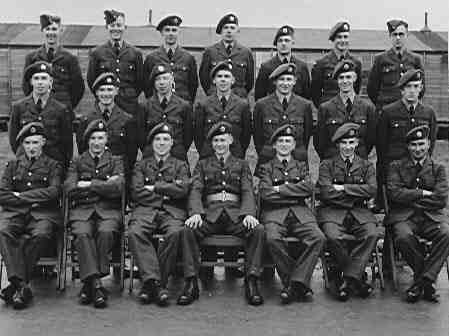
This
photograph was taken in April 1951. It shows the whole intake for a nine-week
period. It was called a ‘Flight’ and comprises three squads. Our four drill
instructors, comprising one sergeant and three corporals, can be seen seated
together in the third row, commencing with the corporal seventh from the left.
The author is sixth from the right in the back row. This group is the No 2 Flight of 93 Intake at RAF West Kirby. The Officer Commanding the Station at that time was Group Captain G F Wood.
After
our initial training we were all sent to different parts of the UK, according to
the trade we had chosen. Never again did I see any of the men that I would have
fought and died for.
I
never ever recaptured that feeling during the rest of my time in the service.
When we were dispersed and I was posted to an active flying unit I became a
civilian again, albeit in uniform. I assume this was because I started to lead a
relatively normal life again. Although I’m quite sure that feeling would have
rapidly changed if the Cold War, which existed at that time, had suddenly become
‘Hot’.
There
have been many different opinions about the value of National Service over the
years but in my opinion and without trying to sound too pretentious; it made
better citizens of us. It was
a very formative period in our lives and it taught
us a salutary lesson in self-discipline, respect for others and their property.
It helped us to work with other people as a team, although I believe my
membership of the Scout movement had already helped me to some extent in this
area. I also think that, to some degree, discipline
was instilled into us before we ever entered the Service because of the social
climate that prevailed in that era.
Trade
Training (Signals)
I spent
most of my National Service at RAF Upwood but my twelve-week initial trade
training for Air Traffic Control was carried out at Compton Bassett in Wiltshire
and Stradishall in Cambridgeshire.
RAF
Stradishall was a jet fighter station and I was initially astonished to see that
the pilots were almost as young as myself until I realised that the many of the
wartime Spitfire and Hurricane pilots were flying well before their 21st
birthdays.
At
a recent ‘Battle of Britain’ celebration at RAF Northolt I met an
ex-Spitfire and Hurricane pilot, aged eighty, who informed me that most of the
pilots he was stationed with, although they were great at flying Spitfires, had
never learnt to drive a car!
When
I arrived at RAF Upwood they had four squadrons of Lincoln bombers in constant
flying readiness. I proceeded to work in the Control Tower (photo below) where I
spent my time listening out on the RT and clearing aircraft for take-off or
landing and keeping a log of same.

Sometime
later, but still in Air Traffic Control, I was sent to work in the ‘Homer’.
The
Homer was a small, conical shaped timber building, situated on the far side of
the airfield. The only building that was further away than the Homer was the
Bomb Store.
The
double skin of the timber walls of the Homer was designed to encase gravel,
which was to provide some protection from enemy machine bullets or shrapnel.
It
was remote and isolated from the rest of the station so that it received as
little radio and electrical interference as possible and in the event of a
wartime attack on the station it would, hopefully, remain unscathed and
operable.
If
there had been an attack none of us would have survived anyway because most of
the gravel had either been removed or had never been put in there in the first
place. The main occupants of the hollow walls were king-sized rats.
It
was emphasised in our training that, when we were posted to our operational
stations, each one of us would be responsible for the safety of a crew of seven
men and a four-engined bomber every time we made RT contact with a pilot.
This
thought was always in the back of our minds whilst we were on duty and caused us
some consternation for two reasons. Duty in the Homer was a lonely existence
because it was a single man operation and very tiring at times. We were
generally short-staffed and on occasions the night shift would commence at 17.00
instead of midnight and finish at 08.00 hours – a period of 15 hours.
We
weren’t allowed to sleep and fifteen hours was a long time to remain alert,
particularly in a small, dimly lit room. The second reason was the fact that the
equipment we used was considered state of the art in the war, but by the early
50s it was well-past its
sell-by date.
The
main function of the Homer was to send and receive radio bearings to aircraft to
enable them to either establish or confirm their position in the air.
The
equipment was very basic. It consisted of a rotating aerial which turned through
360º and was manually operated by the RT/DF (Radio Telephony/Direction Finding)
operator. Degrees were marked on a scale at the base of the aerial and were
clearly visible to the operator.
When
a pilot or navigator wanted a bearing to establish where he was, in relation to
RAF Upwood, he sent a transmission to the Homer operator. The operator would
then request a 15-second transmission from the plane. When this commenced he
would then spin the aerial and find one of the two gaps, or ‘deadspaces’ as
they were known, that always exist in radio transmissions and are 180º apart
from each other.
One
of the ‘deadspaces’ indicated the direction of the transmission. The trick
was to find the correct one and this was done by depressing a switch whilst the
transmission was taking place.
A
rise or fall in the transmission at this point would ascertain which of
the two ‘deadspaces’ was the correct one. This was not as easy as it sounds
because, on occasions, the difference between the two was imperceptible. The
operator would then transmit the bearing shown on the scale in front of him. A
bearing of this kind could only establish the direction of the aeroplane in
relation to the Homer; it could not pinpoint a position. If the pilot or
navigator wanted to establish his exact
position in the sky over the UK or Europe, he could call on at least one other
Homer, or possibly two; on other RAF stations and obtain further bearings. This
information would be passed on to the aeroplane’s navigator enabling him to
triangulate the bearings. There was a little more to it than that but that was
the basic procedure.
The
entrance to the Homer was through thick ‘bunker-like’ wooden doors. They
could not be locked from either the inside or outside. Your security was
determined by the strength of the broom handle that was thoughtfully provided by
the Royal Air Force which you were expected to put through the inside door
handles when you were on duty inside.
When
the aerials got wet the accuracy of any bearing was severely diminished. I used
to wonder sometimes how we ever won the war. I couldn’t imagine a German Homer
operator having to climb up to the top of his Homer every morning, as we did, to
dismantle the aerials and dry out any rainwater or condensation that had formed
within them. It also seemed very unlikely to me that the Luftwaffe would utilise
ageing wooden broom handles to protect the direction-finding capabilities of
their operators.

The
Homer, showing the author carrying out the daily ritual of removing the moisture
from the aerials.

The
interior of the Homer, showing part of the direction-finding equipment,
The
problem of direction finding with moisture in the aerials manifested itself in a
most unfortunate manner on one occasion when I was on duty. A new Commanding
Officer had been appointed to our station and had decided he would fly himself
there in an ‘Airspeed Oxford’ aircraft provided by the Air Force.
His
first contact with his new station was made when he requested a bearing from me
to enable him to fly directly to RAF Upwood. I promptly gave him a bearing,
which he queried ten minutes later to say that he was just passing over the East
Coast and heading out over the North Sea.
This,
of course, was exactly the opposite direction to which he should have been
flying and he was naturally curious, and probably a little alarmed, as to the
accuracy of the information I had provided him with.
I
knew then from my experience, that with the rain pouring down outside the Homer,
it would nullify any chance of me being able to provide a bearing in the normal
manner, with any accuracy, as laid down in our training. The prescribed way of
ascertaining a bearing was to do it aurally.
However,
every Homer operator knew of an unconventional way of doing this electrically.
We always found it to be more accurate than the aural method but it had been
prescribed illegal by the powers to be. Homer operators rarely used it for this
reason.
By
operating the controls in a different manner and by reading one particular dial
on the board that denoted the AGC (Automatic Gain Control) it would interpret
the signal from the aeroplane more accurately, even when the dipoles were damp.
So for my second transmission I used this method.
After the new CO had landed safely he reported this affair to my Wing Commander, the officer in charge of Air Traffic Control, who promptly sent for me when my shift ended.
I viewed
this meeting with some trepidation for three reasons. The first was the fact
that I knew I had severely embarrassed the Wing Commander. Secondly I felt that
I was in a no-win situation by giving two different bearings, one of which was
obtained illegally, by Air Force standards, and thirdly I knew that my offence
warranted an automatic court-martial. The verdict, if convicted, was the loss of
rank, a minimum of six months detention in a Service prison in Colchester and a
dishonourable discharge.

The
new Commanding Officer’s Airspeed Oxford safely in a hanger at Upwood.
I
felt my position had dramatically shifted, within a few hours, from being a
civilian in uniform to a serviceman who was about to get kicked out of the
service after a very unpleasant six months in the ‘Glass House’, as the
Service Prison in Colchester was called.
As
I marched to the Wing Commander’s office I even began to view my offence with
further alarm by mentally writing the headlines in the following day’s
newspapers – ‘Deranged airman responsible for attempted manslaughter of new
CO’!
After
I had presented the facts to the Wing Commander he passed them on to the CO who
decided to let me off on that occasion with a warning. It never happened again.
Shortly
after this incident the whole direction finding process was replaced with a more
accurate and reliable radar system. This
was operated from the Control Tower, rendering the Homer obsolete.
I’ve
no doubt that, in his position, the new CO was fully aware of the changes that
were about to take place and I would like to think that he thought it would have
been unfair to have me penalised for endeavouring to operate ageing and
unreliable equipment.
Off Duty Life
National
Service was, of course, compulsory although it could be deferred if you were
studying for a professional occupation. In my experience, the majority of people
preferred to come in at eighteen and do their National Service so they could get
on with their civilian lives.
The
Signals Section, which I now belonged to, was housed in a brick-built barrack
block containing eight rooms, four on the ground floor and four on the first
floor. Each of the larger rooms contained thirty men, with the addition of a
smaller room for the corporal in charge. After the primitive huts I had lived in
during my basic training this new accommodation seemed luxurious to me. We even
had central heating, which I had never experienced before.
As
you would expect, each block contained an interesting and varied mix of male
society. There were the lazy and the workshy, the budding politician, the mean
and the generous, the hard and the soft, the shy and the extrovert, the
‘duckers and divers’
and the innocent - and then there would always be a comedian.
The
entertainer in our room was Bill Jones. He was a natural born raconteur and a
very nice chap although it was generally not safe to leave your cigarettes lying
around in his presence. His silhouette has been recorded for posterity in a
scene from ‘Appointment in London’ which was filmed at Upwood. Bill can be
observed, in the unlikely role for him, of guarding a Lancaster bomber.
Living
with thirty men was an excellent way of learning about, not only other people,
but yourself. One day I remember being summoned to the Wing Commander’s
office, with two of my colleagues, to receive a ‘rocket’ for some
misdemeanour. Whilst we were standing outside, one of the men, who of course
shall remain
nameless, was so scared that he wet himself. It was interesting to note
that the other chap and I, although we had both seen the pool of water at this
fellow’s feet, chose to ignore it rather than embarrass him. Prior to this
incident he had always acted as though he was a ‘hard case’.
Many
pastimes could be undertaken on the Station such as cricket, football,
gymnastics, basketball and archery. The occasional airshow was put on, for the
benefit of the general public, which we also enjoyed. On a more mundane level we
were still expected to keep the room, toilets and showers clean and tidy and
this was done on a rota basis, although we still had to make our own beds.
Things
were more lax in our block than some because it housed a high proportion of
shiftworkers. Although this was true in the case of some airmen, others were
known to take advantage of this. They knew that officers on inspection duties
were reluctant to enter our domain in case they were accused of disturbing our
sleep.
Our
laundry was sent away to be cleaned but we darned our own socks. As well as
occasionally cleaning the showers I used to practice my trumpet in there - the
highly glazed surface was great for resonance!
The
camp had it’s own cinema called the ‘Astra’ which had the added attraction
of a running commentary from the patrons, which could be incredibly funny if it
was a poor film. If you wanted to enjoy a film without interruptions it was far
better to go to Ramsey or Peterborough.
There
was the opportunity of being able to play table tennis, snooker and billiards in
the NAAFI. For any non-service personnel, unfamiliar with the acronym, it stands
for Navy, Army and Air Force Institute. As far as I am aware there is a NAAFI on
every base in every service. They are clubs for servicemen where they can relax,
drink, and have a meal without having to leave the station.
I
can recall that whenever someone dropped a plate in the NAAFI or indeed the
Mess, everyone cheered. This became an automatic, Pavlovian reaction which, 50
years later, I still have problems with. These days I find that, whenever I am
in a restaurant and someone drops a piece of china, I have to stifle the urge to
cheer. I know of other ex-servicemen that have the same problem.
At
that time there were no WAAFS stationed at RAF Upwood. Therefore, many of us
used to walk into the local village of Ramsey and visit the local dance hall
where we could listen to ‘live’ musicians instead of records and also
rectify our need for feminine companionship. We would hover on the edge of the
dance floor like praying mantis and ‘chat up the birds’. The
Ramsey dance hall also held dancing classes and roller skating nights
The
village of Ramsey played a big part in our social lives because it also
contained many pubs, the ‘Copper Kettle’ tea rooms, and an excellent cinema
which is still going strong, even after all these years.
If
we felt more adventurous we would catch a bus to Peterborough and either visit
the cinemas or sample the sundry delights of the Mansfield Dance Hall with
similar lustful thoughts as before.
In
the climate of the 1950s they generally remained only thoughts but, just
occasionally, there was a breakthrough.
After
wearing blue serge and boots all day it was a welcome relief to be allowed out
of the camp in our civilian clothes or ‘civvies’ as we called them.
Sometimes it was with other people’s clothes, because we used to borrow from
each other, but the girls always knew we were airmen.
The
other place to relax on the station was the ‘Sally Ann’. This was a less
sophisticated establishment than the NAAFI. In fact it was a wooden hut instead
of a brick building and was run by volunteers from the Salvation Army – hence
the name. They did not serve alcohol but the food was much better than that
served in the NAAFI or indeed the Mess and it was a popular venue for us. Like
many ex-servicemen I have always had a soft spot for the Salvation Army ever
since. Although I am not a religious person I have always admired their
dedication and never fail to contribute to their organisation when requested.
Concerts
were occasionally held in one of the four hangers on the station. A particular
good one was when Frankie Vaughan entertained us. We found him to be a very
likeable individual, without a hint of ego, who presented us with an extremely
entertaining show. His performance was very professional and we enjoyed it
immensely.
This
was more than could be said for another visit to a hanger a few months later, on
the occasion of a station dance. It was the only time I ever felt ashamed of the
Royal Air Force, or at least the ground staff and bureaucratic side of the
service and I never attended another.
When
I entered the hanger that evening with a young lady, I was dismayed to find that
the administration had decided, in their wisdom, to allocate seating according
to rank. Each person attending was corralled into one of three sections. The
area you were allowed to enter was dependent upon your status in the service.
Rank
and privilege were thrown into your face like a wet sponge by the appearance of
large white cards, which had been placed around the walls of the hanger. The
messages on these cards denoted your place in the hierarchy. Printed upon them,
in large black letters, were these three different messages; ‘Officers and their Ladies’
- ‘NCO’s and their Wives’ – and last, but certainly not
least, were the words ‘Airmen and their Women’.
I
was appalled by the offensiveness of the latter and promptly left with my
‘Woman’. It was my first encounter with such crass snobbery. I discovered
much later that the Royal Air Force is perceived to have less of it than the
Army or Navy.

Concerts
and dances were held in this hanger and also the Mess and NAAFI. Frankie Vaughan
appeared here.
Apart from that incident, I enjoyed my period of time in the RAF and made the most of it. But there were a few airmen who were quite bitter about having their lives disrupted in this manner.
They acted as though they were either in bondage or serving a term in prison. Daily they recorded how much time they had left to go before they could leave the service. The calendars they used for this purpose were elaborately filled in every day. In some cases with different coloured inks and this seemed to be the only thing they ever did with any enthusiasm. Once this 'chore' was completed they would spend the rest of the day bemoaning the time they had left to do.
In the main I found them to be the most boring people I met in the Air Force and I suspect that they would be the same in civilian life.
However,
I did sympathise with those that had lost their girl friends when they were
called up. My own experience proved that absence doesn’t always make the heart
grow fonder. At least not when you’re eighteen and your girl friend happens to
be a chorus girl in a Tom Arnold Ice Show at Wembley.
That
was my loss when I joined the RAF but one of the airmen in our barracks was
going out with Petula Clark at the time. She was a famous and beautiful singer,
and we all felt a mixture of envy and sorrow for him. Envy at going out with her
in the first place and sorrow at him losing her.
The
proceedings in the barrack block were enlivened on the odd occasion when airmen
fell out over money; cigarettes or card games and the occasional fight would
ensue.
In
the case of some people it was sheer boredom that prompted them to do this.
Luckily no serious injuries were ever witnessed and the fights, such as they
were, acted as a release valve for some people. It was interesting to note that
you could leave cash on your locker and it would remain undisturbed but
cigarettes were a different matter. They would rapidly disappear if you turned
your back on them.
If
it wasn’t there already, cleanliness and tidiness was instilled into us at
‘square-bashing’. It was paramount in a room housing thirty men but on one
occasion a newcomer to the camp seemed to have slipped through the net and had
no intention of bathing at all. After a few days his distaste for soap and water
became apparent to us and we instructed him to have a bath or shower or else!
He
was underwhelmed by our threats and continued to resist what he regarded as the
evils of soap and water. After five days of this we thought enough was enough.
One of the baths was filled and he was thrown bodily into it fully clothed. He
was threatened with a daily ducking like that until he accepted that personal
cleanliness was an option he would be well-advised to adopt. I also think the
imminent threat of drowning was a strong motivation for his rapid change of
behaviour.
The
Good, the Bad and the Ugly

Off
duty high jinks outside our barrack block. John Cater is the guy being carried.
Because of the number of ‘Johns’ we had, we nicknamed him ‘Eddie’.

The
above photo was taken behind our barrack block on 16th September 1951
and shows, from left to right, the author, John, Jim Berthals, Pete, Frank , Jim
Tyler.
|
|
|
|
|
|
|
|

Note:
Even though I cannot remember their names, these are some of the decent guys I
met and served with at RAF Upwood.
Sex
In
the 1950s people got married first and then lived together. We had ‘crumpet’
for tea and ‘making out’ referred to how you did in exams. A ‘stud’ was
something that fastened a collar to a shirt. ‘Going all the way’ meant
staying on a bus until it got to the depot and Aids meant a beauty treatment or
help for someone in trouble.
It
would have been social suicide for a gay person to have come out during that
period. As far I know we only ever had one in our billet during the three-year
period I was at RAF Upwood. This was only confirmed after he left the service.
He was suspected of being gay at the time but only because he used a
particularly strong aftershave and deodorant. It seems extraordinary now but, at
the time, these items were not in common usage amongst the male population and
were considered rather effeminate.
Gay
men in those days were referred to as ‘queers’, ‘poofters’ and ‘shirt
lifters’. Some of us were not sure exactly
what went on between consenting males and we didn’t even think about lesbians.
Prior
to going into the Services, I was advised to watch out for the ‘Golden
Rivet’ by an ex-naval man, who worked in the same office as me.
I
wasn’t sure what he was talking about, because at the time, I couldn’t
accept that what he was saying as being the truth. I would have felt the same
way about paedophilia if I had known about it then. In common with most
eighteen-year olds at that time, I still had a lot to discover about human
depravity.
As
young men in the 50’s, we were learning about life in the rawest sense of the
word. Our biological clocks told us we should be, to use a much-used euphemism,
‘making love’. We all knew about it, of course, but very few of us had
activated the mechanism. Initially, most of us thought the ‘Karma Sutra’ was
a dish of curry and the ‘Perfumed Garden’, a manual for horticulturists.
For
18-year olds who were away from home and without the restricting hand of
parental disapproval, something that mattered in those days, sexual activity or
more commonly, the talk of sexual activity was a popular topic of discussion.
What I generally found was that those who did, didn’t talk about it and those
that didn’t, did.
In
the days before the pill, sex was a hazardous undertaking. Even if we did
anticipate that we might be fortunate in our sexual overtures, obtaining condoms
was another hurdle to overcome.
It
was quite unlike the openness of today, where they can be seen on display in
chemist’s shops or in machines in coffee bars, public toilets and pubs. In
those days their purchase was either carried out in relative secrecy in a
barber’s or purchased from a chemist’s shop, where they were kept under the
counter.
Although
you would studiously try to avoid being served by a female assistant, it was
inevitable on occasions for this to happen and would be a source of
embarrassment for the prospective male purchaser. If this happened too
frequently you ended up with a considerable amount of toothpaste or aspirin
tablets!
Contraceptives
were very basic in those days. We didn’t have the sophisticated colour range
of the United Colours of Benetton, catering for all anatomical sizes. There was
also no ‘flavour of the month’ such as there is now. Contraception was a
case of either abstaining or using what felt like the inner tube of a forty
tonne truck
The
most popular venue for purchasing contraceptives was the camp barbershop. This
was the only place where we were certain a man would serve us and it became a
popular venue for budding ‘studs’.
After
a barber had completed cutting your hair in those days, he would cast a glance
over his shoulder and ask you, rather furtively, if you wanted ‘something for
the weekend Sir’. It was an inner circle of
sexual conspiracy and was enacted like a
secret transaction and carried out as though you were a couple of spies
exchanging clandestine information. It was quite a surprise when I eventually
realised what was going on. Because prior to joining the RAF, although
intrigued, I innocently assumed that barbers were perhaps selling sweets or
cigarettes.
Our
camp barber did a lot of business in that area. Some airman with a high libido
became unusually good customers and were having their hair cut much more
frequently than was considered normal. It didn’t seem good manners to go into
the barbers and ask for ‘something for the weekend’ if they didn’t have a
haircut first.
The
barber eventually changed his
dialogue from ‘Something for the weekend sir’ to ‘Something for the
evening sir’. I had the impression he made more money from selling condoms
than in cutting hair.
For
some, the initial fumblings took place in the air raid shelters that used to
exist around the camp, behind Ramsey dance hall, the side of the cinema and bus
shelters.
We
were rarely invited back home to meet Mum and Dad. As far as they were
concerned, servicemen were considered persona non-grata. Nowadays, as a
grandfather, I can understand their feelings.
The
most unlikely venue for romance for most normal people, would be a church
graveyard. However, this was the setting for the lustful overtures of two
airmen. For the sake of this
story I shall call them ‘Bob’ and ‘Dick’, which seems to be singularly
appropriate in the latter’s case.
Following an evening at the cinema the two young
Lotharios in question, decided to visit the graveyard to have their
evil way with two of the local girls. With a full moon shining it promised to be
a romantic evening until ‘Dick’ demanded a great deal more from his girl
friend than a free trip to the cinema warranted.
This produced a rapid response from the female in
question who decided to remain ‘virgo intactico’ and leave the scene
post-haste. At the time, ‘Bob’ felt that this could have been for one of
three reasons or perhaps all three. ‘Dick’s’ bad breath; the imminent
threat of being seduced on top of a moss-covered gravestone with the name of a
dead ancestor being imprinted on her backside, or the awesome size of
‘Dick’s’ member!
There ensued a surreal chase through the graveyard with
‘Dick’ in hot pursuit, swinging from side to side in an ape-like manner like
the orang-utan he closely resembled. His guttural cries of ‘Come ‘ere my
beauty’ did nothing to allay her fears.
When
my friend ‘Bob’ relayed this story to me, he
said it resembled a scene from a pornographic horror movie. Unfortunately, in
his haste to give chase, ‘Dick’ had omitted to cover himself up. As he pursued the panic-stricken girl through the
churchyard, his trousers were still around his ankles and his manhood was seen
to be swinging in the moonlight.
It didn’t help to reduce the girl’s panic to see that
this part of his anatomy was large enough to frighten horses. In fact, his
monstrous reproductive organ was an anatomical sequoia.
It was an abrupt introduction to sex for a young Ramsey
lass and these days she would have probably been offered counselling after such
a traumatic event.
It
was the stuff of nightmares for this poor girl. It’s a sobering thought to think that the young lady in question is
probably nearly seventy years old now, assuming of course that she survived the
stress of the incident.
‘Bob’ told me that he was quite annoyed about the
whole episode because, up until that time, he had been laying on an adjacent
tombstone with his girlfriend and his anticipated copulative activity was
abruptly curtailed by this intrusion into his amorous advances.
Incidentally, this was his second frustrating episode in
succession, because the previous evening, whilst engaged in a similar activity
by the side of the cinema, his anticipated and forthcoming climax was marred by
the girl asking him, in the middle of the proceedings, if he’d ‘Got a fag
Bob?’
Everyone in our block was well aware of ‘Dick’s’
gigantic flexible friend. He was extremely proud of it and exposed it at every
available opportunity.
As far as he was concerned he had won the lottery in the ‘Mr Bendy’ stakes.
As well as having a charisma bypass, dignity
and self-respect had passed him by. He had absolutely no redeeming features at
all and when he was ‘demobbed’ none of us were sorry to see him go.
‘Dick’ was one of the most unpleasant people I ever
came across, either in the RAF or my civilian life. Up until that time, I didn’t realise that people like him existed.
Serving in ‘His Majesty’s Forces’ was a great place to enlarge your
knowledge of the complexities of your fellow man.
Many amusing and interesting stories that circulated
during the time I spent in the Royal Air Force are the stuff of urban legends.
The incidents that were related had always happened to
someone else and, not that it mattered, but you often wondered if they were
true.
These stories mainly consisted of schemes to extract
money from newcomers to the Air Force.
These new recruits had been abruptly thrust into a
system, which had bewildered and confused them. According to the legends, they
were preyed upon and led like lambs to the slaughter.
Some regular airman, who had been in the Air Force for a
considerable time, were known to utilise their extensive knowledge of human
nature and the ‘system’ to get up to all sorts of tricks to ‘fleece’ the
new recruits. Unless these newcomers were ‘streetwise’ before they
came into the service, and that was very rare, these ‘sprogs’ as they were
known, were very receptive to any older airmen that proposed a suggestion to
them by the force of their personality.
One of the ‘scams’ practised on new recruits, that I heard about, was the pseudo raffle.
Two ‘old sweats’ would enter a billet full of new
recruits on payday and sell raffle tickets, which guaranteed that the winner
would receive a brand new electric iron. This created a great deal of interest
because it would have been a useful item to acquire to enable you to press your
uniform.
The iron was never won by anybody. If enquiries were made
as to the identity of the winner, they were told it was someone in another
block. That same iron was ‘raffled’ with every new intake of gullible
recruits.
Another method of exploitation was the trick that was
supposedly practised by the corporal in charge of a roomful of thirty recruits.
On the table in the centre of the room he would stack coins up to the height of
three inches. He would then issue a challenge to the assembled throng that if
anyone of them had a member that was longer than the coins displayed they could
claim the money on the table. If not, they would have to pay the corporal the
equivalent amount.
Upon hearing of such an unusual challenge there was an
initial shock of disbelief. When this had receded it seemed to these young
airmen that this could be an easy way to enlarge the financial pittance they
received from the Air Force.
There followed an unseemly display, by these innocents,
as they all scrambled forward, in varying states of exposed disarray, to claim
the reward.
Once the corporal was satisfied his potential victims had
fallen into his trap, he took the pile of coins and laid them on the table
lengthways. From a previous height of three inches, the coins now became a
continuous length of twelve inches.
None of his audience was endowed with such an enormous
weapon but to gasps from his stunned audience, the corporal would produce his
own awesome equipment, covered the coins with ease, and collected his bounty.
Once again, this would happen with every new intake.
In the early fifties the wages of a two-year National
Serviceman were 28/- per week (£1.40) and a three-year man received 45/- per
week (£2.25). We were paid in Sterling. Decimal currency didn’t arrive until
1971.
Pay Day took the form of a parade in front of a table at
which sat an officer and a pay clerk. Each airman had to march up to the table
when his name was called, throw up a salute, give the last three digits of his
service number and then he was paid in cash.
When we were all paid and then dismissed and certainly
after the officers had left the scene, the stage was then set for the weekly
degeneration into a free-for-all. This would occur when the moneylenders
(usually three-year men) descended upon their hapless customers. The latter did
their best to retain their 28 shillings and were the first ones on their toes
and away from the scene as soon as possible.
Although we couldn’t afford to eat at the ‘Ritz’,
most of us managed to survive on our pittance because, as in all the services,
bed, board, clothing and laundry were provided for you. Our only expenses were
those of a personal nature such as sweets, cigarettes, beer, bus fares and
contraceptives.
If
you didn’t overdo it you could survive. We were not subject to the temptations
of pizza and curry houses, Chinese take-aways, kebab shops and designer coffee
bars because they didn’t exist at that time in the UK.
I must admit this did help to concentrate the mind
whenever you were in the air. You hoped that your opposite number on the ground
had done, or was doing, his job properly.
Because these flights were so readily available, I was
surprised to learn that, out of a camp of 2,500 airmen, only half a dozen of us
ever availed ourselves of this ‘once in a lifetime’ opportunity.
The aircrew were particularly easy to get on with,
whatever their rank. They appeared to have a very relaxed attitude to life,
unlike the admin section. In the air it was Christian names all around which,
after the strict discipline I had been subject to for the past few months, took
some getting used to at first.
This was my first lesson in working with ‘top
management’ in a relaxed manner. I learnt that this could be achieved whilst
still operating professionally. You never stepped over the invisible line that
delineates the employee from the employer. You respected each man for the role
he was playing and the pilot was still the boss.
No
doubt the camaraderie of the crew was a crucial element to their survival in the
war. Some of the wartime pilots probably
also felt very fortunate to have come through the last war unscathed, unlike a
lot of their colleagues.
The pilots themselves were only too happy to take us up
whenever we requested it. I remember presenting myself at the squadron
headquarters one Saturday morning to see if a flight in a Tiger Moth was
available. An officer pilot, who was about to go on a thirty-six hour pass, very
decently I thought, delayed his departure to take me up for a few hours.
You were allowed to take the controls of a Lincoln bomber
or a Tiger Moth once they were airborne and in level flight. Occasionally you
were allowed to land the Tiger Moth as well. In this biplane, the passenger sits
in front of the pilot and it was exciting stuff for an eighteen-year-old. Even
more so when I found out that this particular aeroplane has no brakes, so that
when you land you have to slow it down with the throttle.
As you walked out to the plane wearing a flying suit, thick fur-lined flying boots, goggles and a parachute you looked and felt like ‘Biggles’. The parachute that you wore in a Tiger Moth was different from the one used in a bomber. You sat on the former as though it was a cushion. When you strapped it on and walked out to the plane it continually banged on your backside.

The author, is seen here with a Tiger Moth parachute,
helmet and goggles.
The parachute for the bomber had a handle on one side so that you could carry it like a suitcase. If you ever needed to use it for its chosen purpose you had to clip it to the harness on your chest. When you baled out and prior to pulling the rip-cord, which was in the shape of a handle, you had to put your left hand over your chest to stop the parachute breaking your neck as the speed of your descent forced it open and upwards. This instruction I was given became purely academic because, luckily, I never had to use one.
The Tiger Moth was such a beautiful aeroplane to look at
and fifty years later I still think so. With its open cockpit it was a draughty
machine in which to fly. However, with the wind rushing over your face it was
exhilarating and I can only liken it to the thrill of riding an imaginary aerial
motorbike.
It was certainly not ‘package holiday’ flying, which
is just a means of getting from A to B. This was flying as I had always imagined
it to be. It was the ultimate thrill and I couldn’t get enough of it.
Seeing the beauty of the English countryside from a few
thousand feet on a sunny day was something I’ll never forget. Although I must
say that I was surprised to see some of the cars below us were sometimes going
much faster than we were. Although our top speed was 100mph we generally cruised
at about 80mph.
Years later, when I was using shuttle flights out of
Heathrow to Manchester, Edinburgh, Schipol, Frankfurt etc, surrounded by
businessmen reading their newspapers, it was interesting to see how mundane
flying had become. I realised that if I hadn’t experienced the thrill of being
aloft in a Tiger Moth I never would have known how exciting flying can really
be.
When flying in a Tiger Moth we stayed over the UK but in a
Lincoln bomber we sometimes flew all over Europe. On most occasions I was
allowed to hold the controls which was very exciting for me but I was relieved
to have had the reassuring presence of the pilot seated alongside me in the
co-pilot’s seat.
A particularly interesting flight was the one I made in a
Lincoln in 1951. Accompanied by two other bombers we flew down to London at an
altitude of 1000 feet and pretended to bomb the White City Stadium.
This event was organised by the Soldiers, Sailors and Air
Forces Institute (SSAFI) and was designed to celebrate Battle of Britain day.
When we were directly over the stadium, explosives were
detonated in the stadium arena to simulate bombs being dropped by us.
I had a superb view of the whole proceedings in the
Observer’s/Bomb Aimer’s position in the front of the aircraft. However, I
spent most of my time over the ‘target’, looking to see if my forewarned
parents were waving to me from their back garden. We continued to fly low over
several other stations in Southern England before returning to Upwood.
The only negative side of flying in a Lincoln was the
engine noise in the cockpit. Even though we all wore helmets and oxygen masks, I
found that after a few hours in a Lincoln I couldn’t hear properly for days
afterwards.
The only way you could converse in a wartime bomber was
via the headphones. Films often show the pilot and co-pilot chatting away in a
normal manner, which was quite impossible over the engine noise. You could shout
at the top of your voice into someone’s ear and they wouldn’t be able to
hear you. In fact the noise factor was similar to a few discos at wedding
receptions I’ve been to in recent years.
To
illustrate how loud the four engines of a Lincoln bomber could be we need to go
to a story about the Royal Australian Air Force which I quote from an excellent
book entitled ‘Lincoln at War 1944-66’ by the authors Mike Garbett and Brian
Goulding.
Near to the end of the downwind leg of Townsville's
main runway lay Worth Zoo, which kept a fine selection of monkeys.
During one night-flying training session, the tower
received a 'phone call from an irate zoo-keeper to say the Lincolns had been
responsible for the deaths of all his prized monkeys. It appears they slept on high perches and branches by being able to
lock finger and toe muscles round them.
As the Lincolns selected 2,850rpm overhead the zoo,
the noise and harmonies of the unsynchronised propellers in peculiar atmospheric
conditions had caused the unfortunate animals to release their holds and fall
30ft or more to their deaths.
As a result the zoo not only had to have its stock
replaced, at considerable cost to the RAAF, but also to be fitted with a red
flashing beacon to warn the Lincoln crews.
Another regular complainant was the owner of a drive-in cinema, which was directly under the base-leg turn. The howl of four Merlins passing overhead at only 1,000ft could be quite uncomfortable for the picturegoers on a warm, still night.
A
hypnotist lived in the suburb, which started just
beyond the end of runway 02. He,
too, complained but as he was reputed to make illegal use of young ladies in his
sessions, he got little sympathy from the crews. After each complaint, they
would purposely hold down their fully laden Lincolns a little lower on night
take-offs. The noise of four Merlins at 3,000rpm made life very difficult for
the hypnotist.
The
Avro Lincoln first flew on the 9th June 1944. It was originally
designated the Lancaster IV or V, according to the type of engines fitted. Its
improvements over its predecessors included a greater wing span, improved
engines with four bladed propellers and a longer fuselage.
It
was the last piston-engined bomber to be
used by the Royal Air Force and the surrender of Japan deprived it of a chance
to prove itself in World War II.
Whilst the operational history of the Lincoln cannot
match that of its more glamorous wartime forebears, it was an important
aircraft. It became the main workhorse for the RAF bomber squadrons in the
immediate post-war years, successfully bridging the gap between the wartime
Lancaster and the jet-age V-bombers. It acted as a testbed for jet engines,
equipment and techniques and was widely used for training.
Not that the Lincoln’s role was entirely peaceful. It
was used in active policing and deterrent duties in all the trouble spots of the
1950s – Malaya, Aden and Kenya.
When there was some political trouble in Egypt in January
1952 I remember the whole station being put on standby. All leave was cancelled
for an indefinite period as one of our four squadrons flew out to the Middle
East to assist in the problems our Government was having out there. This was a
situation that occurred several times that year.
As we flew over Europe in the comparative safety of peacetime
and saw the hundreds of wartime bomb craters below us, I felt extremely grateful
that I never had to fly into combat in Lancaster bombers. I knew that flying in
the war over enemy territory would have been a completely different story.
As we flew along I often used to reflect on the bravery of
those wartime bomber crews and how vulnerable those men were in those relatively
slow moving aircraft. The difference between
a fighter and a bomber was like comparing a high-speed motor launch with a
battleship.
The top speed of a Lancaster bomber was 287 mph.
The maximum speed of a German Messerschmidt Bf 109 fighter plane was 428
mph but it was also far more manoeuvrable of course. These enemy fighters would
have been constantly attacking the Lancasters on their bombing runs over Europe.
Night after night there was the constant risk of being shot down over enemy
territory, not only by fighters but also from the enemy anti-aircraft fire from
below.
In the early part of the war it was not unusual for 50%
of a squadron of our bombers to be destroyed by enemy action. There was always
the ever-present risk of a shell igniting the heavy bomb load and on numerous
occasions it did. It gives one pause for thought to think that over 55,000 RAF
Bomber Command aircrew were killed in action during the Second World War.
I was overawed at times when I was in the air, because in the war, men like these had been my heroes and here I was flying with some of them.
The word hero has been denigrated these days and reference is made to it when referring to such people as sports personalities. I mean no disrespect to the other Services when I say that the men of the Royal Air Force Bomber Command were true heroes. They had immense courage and helped to save this country from annihilation. In company with the majority of people of my generation, I have nothing but respect and admiration for them.

Note:
This is Lancaster PA474 (Mk B1) photographed at RAF Northolt this year. It is
one of only two Lancasters remaining in airworthy condition out of the 7,377
that were built. It can normally be viewed at the Visitors Centre, RAF
Coningsby, Lincolnshire..

The
Lincoln was eventually superseded by jet-engined bombers such as the Canberra,
Valiant, Victor and the delta-winged Vulcan.

The
de Havilland Tiger Moth entered service with the RAF in 1932 and, until 1947,
was primarily responsible for the elementary flying instruction of all RAF air
crews.
It
was the last biplane trainer used by the RAF and over 8,800 were built. It is
one of the most famous and well-loved aeroplanes and many can still be seen
flying today.
Epilogue
For
any
reader who is interested in finding out more about the Avro Lincoln may I
suggest that they read ‘Lincoln at War 1944-1966’. This is an excellent book
written by Mike Garrett and Brian Goulding, which was first published in 1979.
Although
I flew in the Lincoln bomber as a passenger on many occasions, apart from the
radio equipment, I never fully understood the aircraft’s background or
technical details. However, after recently reading this excellent book I’ve
learnt more about them in the year 2000 than I ever did when I was in the RAF in
the 1950s. Most of the material that you can read in this fine book was probably
restricted at the time.
Another
excellent publication which I also used for research and one which I would also
like to credit is ‘The Armies of Britain 1485-1980 by Michael Barthorp
When
I was requested to write this memoir I wondered, at first, if I would remember
all the details. However, after chatting to my ex-service friends, such as John
Cater, Tony Saint and Don Ticehurst, most of the main incidents came flooding
back to me. All of these friends were instrumental in ‘kick-starting’ my
memory regarding the events of fifty years ago, for which I’m grateful.
I
would like to say that it’s fashionable these days for some of our
pseudo-intellectuals to say that
National Service was a ‘bad’ thing. In my opinion, its reintroduction to a
lot of young men at the age of eighteen would be beneficial for many of them. It
would give them a direction and sense of purpose in their lives. Not to be
compulsory but taken as an option and be reasonably well paid.
They
could be used as part of an international unarmed task force to assist in times
of crisis such as flooding, earthquakes, volcanic eruptions, famine relief etc.
A
combination of the training and experience in the various skills that the Army,
Navy and Air Force could provide, for a period of eighteen months to two years,
could benefit, not only the Nation, but also the teenagers themselves.
I
won’t hold my breath waiting for it to happen!
Finally,
I would like to dedicate this article to friendship. The following photographs
were taken at RAF Upwood, but fifty years apart. The first shows myself and my
friend John Cater when we were serving together there. The second was taken by
Sean Edwards, the historian of this website, when John and I visited Upwood
this year, prior to the site being cleared for housing development.
Since the time we spent together in the RAF, John and I
have lived miles apart from each other but have kept in
touch during
the intervening
years. Respectively, we have
seen the arrival of four children and seven grandchildren.
To paraphrase the old proverb ‘The best possession you
can have is a true friend’.
|
|
|
WEB PAGE DESIGNED AND PUBLISHED BY SEAN EDWARDS


